
Rectocele — what it is, and what actually helps.

Rectocele — what it is,
and what actually helps.
If you've been told you have a rectocele, you've probably already met the two unhelpful extremes. One says it's nothing — just live with it. The other hands you a surgical consult before anyone has asked how you actually use the bathroom.
Both skip the part that matters most. A rectocele is a mechanical problem and a functional one — and the functional half is where physical therapy does its best work. Here's what's structurally happening, what the current evidence supports, and what a real course of treatment looks like.
Your vagina and rectum sit side by side, separated by a wall of connective tissue and muscle — the rectovaginal septum. When that support weakens or tears, the front wall of the rectum can push forward into the back wall of the vagina, creating a bulge.
That's a rectocele: a posterior compartment prolapse. It's the same family of condition as a cystocele (bladder into the front vaginal wall) or uterine prolapse — just a different wall.
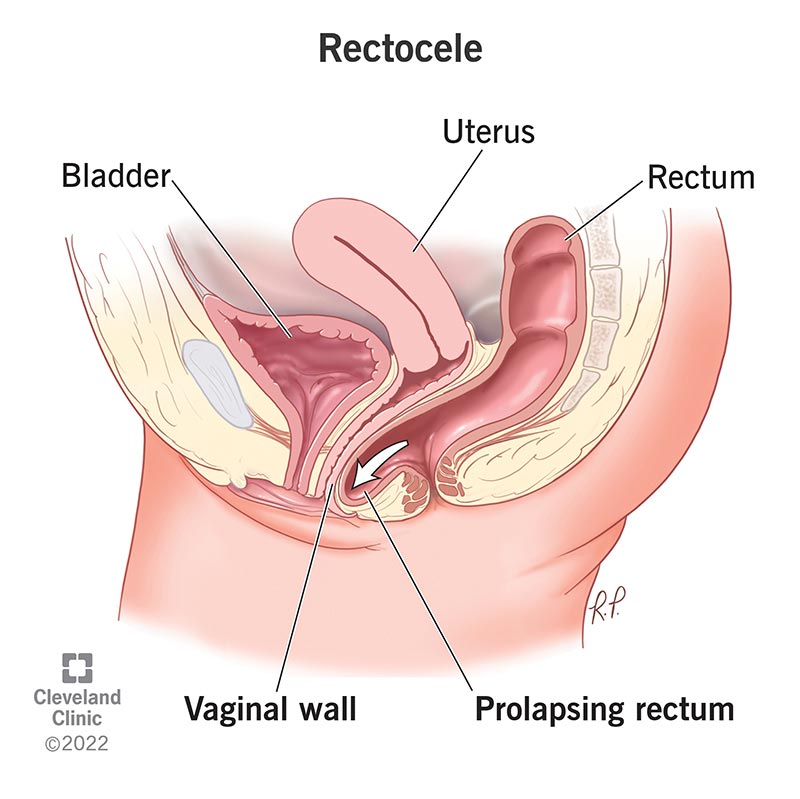
Left: normal support. The rectovaginal septum holds the rectum back, and the vaginal canal stays clear. Right: a rectocele. The weakened wall lets the rectum balloon forward into the vagina — creating a pocket where stool can collect instead of moving toward the anal canal.
That pocket is the key to understanding the symptoms. Stool entering the rectum gets partially diverted forward into the bulge rather than straight down and out. You push, and some of the pressure goes into the pocket instead of through the exit — which is why the defining complaint is so often "I go, but it doesn't feel finished."
Rectocele symptoms are frequently misattributed to "just constipation," which is part of why women wait years before mentioning them. The pattern is usually distinctive:
"I go, but it never feels finished" is not a personality quirk. It's a mechanical description.
Prolapse is multifactorial, but the two most consistently identified contributors are vaginal childbirth and advancing age. Beyond those, anything that repeatedly drives pressure downward through the pelvic floor contributes over time: chronic constipation and straining, chronic cough, heavy repetitive lifting without good pressure management, and connective tissue differences.
There's an important feedback loop here. Straining contributes to prolapse — and a rectocele makes emptying harder, which produces more straining. The condition feeds itself. Breaking that loop is the single highest-value thing conservative treatment does.
The strongest trial evidence for conservative management of prolapse comes from POPPY, a multicentre randomised controlled trial published in The Lancet. Women with newly diagnosed stage I–III prolapse were randomised to either an individualised, one-to-one pelvic floor muscle training programme or a lifestyle advice leaflet with no training.
The training group reported significantly fewer prolapse symptoms at both 6 and 12 months, with the difference exceeding the threshold considered clinically meaningful. That's why individualised pelvic floor muscle training — not generic "do your Kegels" instructions — is now a first-line conservative treatment.
Physical therapy reliably improves symptoms. It is far less clear that it reverses the anatomy. The honest framing is that conservative care changes how much the prolapse bothers you and how well the system functions — not that it puts the wall back where it started. Separately, a 2025 Cochrane review found that adding pelvic floor muscle training around the time of prolapse surgery did not significantly change reoperation or failure rates. Conservative care is a genuine first-line treatment in its own right; it is not a reliable add-on to guarantee better surgical outcomes.
For the bowel-emptying half of the problem, the evidence is stronger still. When difficulty emptying involves dyssynergic defecation — where the pelvic floor and anal sphincter fail to relax, or paradoxically contract, during attempted evacuation — randomised trials have shown biofeedback-based retraining outperforms both sham biofeedback and standard care (diet, exercise, laxatives), with benefits sustained at one year and beyond.
That matters enormously for rectocele, because dyssynergia and rectocele frequently coexist. If you're pushing against a pelvic floor that's contracting instead of opening, no amount of fibre will fix it — and surgery on the wall won't fix the coordination problem either.
Here's what a course of care looks like at Root PT. It's not a single exercise; it's five pillars, sequenced according to what the assessment finds.
You are not trying to push harder. You are trying to make emptying require less push. Almost everything in the protocol above serves that one aim — softer stool, better position, a floor that opens on cue, and pressure directed through the system rather than down into the bulge. Straining is both a symptom and a cause; removing the need to strain is what breaks the cycle.
A pessary — a removable support device fitted vaginally — is a legitimate, non-surgical option that can provide meaningful symptom relief, particularly for pressure and bulge sensation. Fitting is done by a physician or appropriately trained clinician, and it works well alongside physical therapy rather than instead of it.
Surgical repair is genuinely appropriate for some women: typically those with a symptomatic rectocele from a defined rectovaginal fascial defect whose symptoms haven't responded adequately to conservative care. The important nuance from the surgical literature is that posterior repair should be a deliberate, separate decision — not something automatically bundled with other prolapse repairs.
Conservative care first is not stalling — it's better surgical decision-making. If your main complaint is incomplete emptying and the underlying driver is dyssynergia, repairing the wall may not resolve the symptom that sent you in. Sorting out mechanics first clarifies how much of your problem is structural and how much is functional — which is exactly the information a surgeon needs.
Physical therapy is the right first step for most posterior prolapse symptoms — but these need medical evaluation first:
A rectocele is a structural change, but the symptoms that actually bother you — incomplete emptying, straining, splinting, pressure — are substantially driven by function. Function is trainable. That's why conservative care works for most women, why it deserves to come first, and why it makes any later surgical decision a better-informed one.
The other thing worth saying plainly: this is common, it is treatable, and it is nothing to be embarrassed about. The average delay before someone raises these symptoms with a clinician is measured in years — and that delay is the only part of this that's genuinely unnecessary.
- A rectocele is the rectum bulging into the back wall of the vagina — a posterior compartment prolapse.
- The hallmark symptom is incomplete emptying, often with splinting and straining that don't produce results.
- Straining is both cause and consequence. Breaking that loop is the core of treatment.
- Individualised PFMT improves prolapse symptoms — proven in a multicentre RCT (POPPY, Lancet).
- Where dyssynergia is present, biofeedback retraining beats standard care — and it often coexists with rectocele.
- Assessment must include relaxation, not just strength — otherwise the wrong programme gets prescribed.
- Pessary and surgery are real options, but conservative care comes first for most women and sharpens the decision.
This article provides general educational information and is not medical advice or a substitute for individual assessment. Symptoms of prolapse should be evaluated by an appropriate healthcare provider, and any red-flag symptom warrants prompt medical attention.
You don't have to live with this.
Dr. Lorrainne, DPT sees pelvic health patients on-site at Root Strength Georgetown. Private treatment rooms, no referral required in Washington, most major insurance accepted — and we verify your benefits before scheduling, so there are no surprises.
Book an Assessment- Hagen S, Stark D, Glazener C, et al. Individualised pelvic floor muscle training in women with pelvic organ prolapse (POPPY): a multicentre randomised controlled trial. The Lancet. 2014;383(9919):796–806.
- Hagen S, Glazener C, McClurg D, et al. Pelvic floor muscle training for secondary prevention of pelvic organ prolapse (PREVPROL): a multicentre randomised controlled trial. The Lancet. 2017;389(10067):393–402.
- Rao SSC, Seaton K, Miller M, et al. Randomized controlled trial of biofeedback, sham feedback, and standard therapy for dyssynergic defecation. Clinical Gastroenterology and Hepatology. 2007;5(3):331–338.
- Rao SSC, Valestin J, Brown CK, et al. Long-term efficacy of biofeedback therapy for dyssynergic defecation: randomized controlled trial. American Journal of Gastroenterology. 2010;105(4):890–896.
- Shahid U, et al. Pelvic floor muscle training for the perioperative management of pelvic organ prolapse surgery. Cochrane Database of Systematic Reviews. 2025.
- Bø K. Mechanisms for pelvic floor muscle training: morphological changes and associations with symptoms of stress urinary incontinence and pelvic organ prolapse — a narrative review. Neurourology and Urodynamics. 2024;43(8):1977–1996.
- Wang T, Wen Z, Li M. The effect of pelvic floor muscle training for women with pelvic organ prolapse: a meta-analysis. International Urogynecology Journal. 2022;33(7):1789–1801.
- DeLancey JOL, Mastrovito S, Masteling M, et al. Hiatus and pelvic floor failure patterns in pelvic organ prolapse: a 3D MRI study. American Journal of Obstetrics & Gynecology. 2025;233(1).
- Rome IV criteria for functional defecation disorders, including dyssynergic defecation.
- Cleveland Clinic. Rectocele — anatomy, symptoms, and management (patient education resource).