Knee pain going down stairs — and why the knee is rarely the problem.

Knee pain going down stairs —
and why the knee is rarely the problem.
This is one of the most common knees we see, and it almost always arrives with the same apology: "I don't even know what I did to it." Usually the honest answer is: nothing. There was no injury. No twist, no pop, no fall. The pain crept in — around or behind the kneecap — and now stairs, squats, and long car rides all poke at it.
That's not a mystery knee. It's patellofemoral pain — pain arising from the joint between your kneecap (patella) and thigh bone (femur) — and it's arguably the most common single knee complaint in active adults. It's also one of the most mismanaged: rested when it needs loading, scoped when it needs strengthening, and blamed on the knee when the driver usually sits a joint higher.
Most knee problems need an examination before they get a name. This one you can often recognize from the story alone, because the aggravating activities all share one mechanical ingredient: a bent knee under load.
And it is everywhere. A 2018 systematic review put the annual prevalence of patellofemoral pain at roughly one in five adults in the general population — higher in adolescents, runners, and military recruits. This is not a rare or fragile knee. It's the common cold of the lower limb.
Your kneecap isn't decorative. It's a pulley. It sits inside the quadriceps tendon and glides through a groove on the end of the femur — the trochlea — redirecting the force of your quadriceps so the knee can straighten powerfully. Every time the knee bends under load, the patella is pressed into that groove.
How hard it's pressed depends on two things: how much force the quadriceps are producing, and how bent the knee is. Which is exactly why this condition has the signature it has — the activities that hurt are the activities that compress.
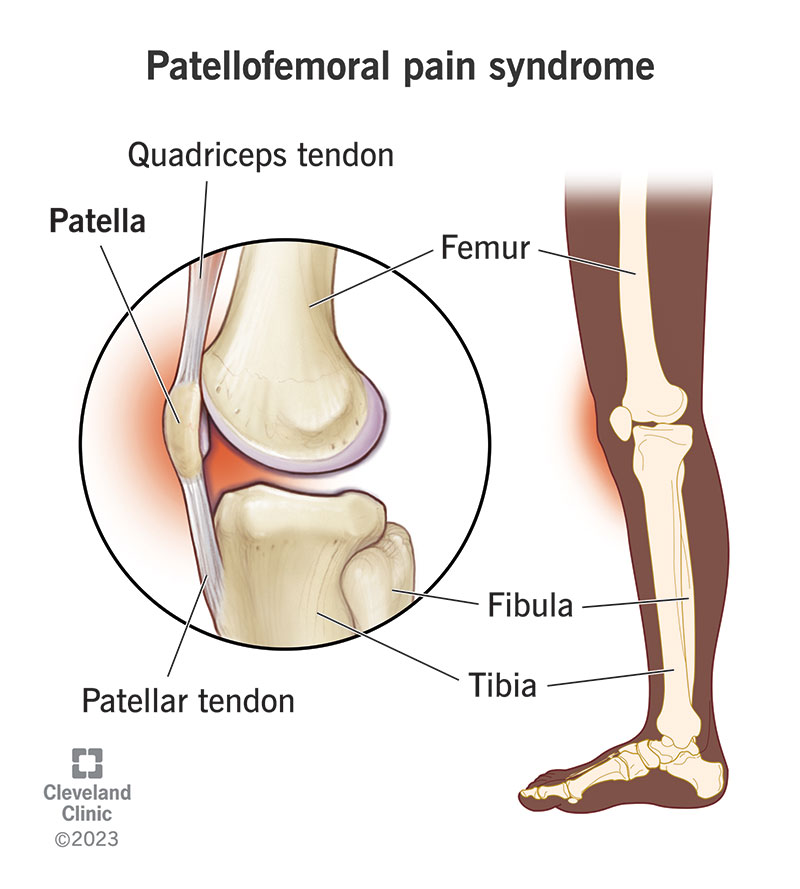
Where it lives. The patella sits at the front of the knee, riding in a groove on the femur and redirecting quadriceps force — which is why the pain of this condition is felt under and around the kneecap. The deeper the knee bends under load, the harder the patella is compressed into that groove, and how the femur rotates underneath the patella changes where the pressure lands.
Now the part that trips people up: in most patellofemoral pain, nothing in that joint is torn, and nothing needs repairing. The problem is that the joint's current tolerance is lower than the load being run through it — because training volume jumped, because the surrounding muscles aren't sharing the work, or usually both. Pain here is a capacity problem, not a damage report.
The knee is where it hurts. It's usually not where the problem is.
Here's what decades of research on this condition keeps converging on. The muscles that control your thigh bone — the hip abductors and external rotators — determine how the femur behaves underneath the patella. When they're weak or poorly coordinated, the femur drifts inward and rotates under load. The kneecap doesn't move out of place so much as the groove rotates beneath it, concentrating pressure where it shouldn't be, thousands of steps a day.
That mechanism would just be a nice theory if treatment built on it didn't work. It does. A meta-analysis in the Journal of Orthopaedic & Sports Physical Therapy pooled the trials directly: strengthening the hip and knee together beat strengthening the knee alone for reducing pain and improving function — with the difference crossing the threshold for clinically meaningful change, and results maintained after the programs ended. The international consensus statement on patellofemoral pain says the same thing: exercise therapy is the single strongest recommendation, and specifically combined hip-and-knee exercise over knee-focused exercise alone.
This is why a good assessment for "knee pain" spends so much time nowhere near the knee. If your rehab program is quad sets and nothing else, it's targeting half the problem — the half the evidence says matters less.
Rest alone reliably fails. Patellofemoral pain is not self-limiting: long-term follow-up studies show that a majority of people managed with "wait and see" still report symptoms years after diagnosis. Rest lowers the pain and the tissue's tolerance together — so the pain returns the moment life does. The evidence-supported move is the opposite: reduce load temporarily, then rebuild tolerance past where it was.
Imaging rarely changes anything. There is no scan finding that defines this condition, and X-ray or MRI is not routinely recommended for it. "Chondromalacia" or cartilage signal on a report correlates poorly with pain — plenty of pain-free knees show the same findings. (This is the knee-shaped version of the story our MRI article tells about backs.)
Taping and orthotics are supporting actors at best. Both can reduce pain in the short term for some people — useful for keeping you training — but neither fixes the underlying capacity problem, and the consensus guidance treats them as adjuncts to exercise, never as the treatment.
And surgery is close to irrelevant here. For garden-variety patellofemoral pain — no instability, no dislocations, no defined structural lesion — arthroscopy has no meaningful role. If someone offers to "clean up" this knee before you've done a real course of loading, ask more questions.
Here's the course of care at Root PT. As with everything we treat, it's not one exercise — it's five pillars, sequenced by what the assessment finds.
Your knee isn't fragile — it's under-prepared for what you're asking of it. Stairs load this joint at several times body weight; that's not a design flaw, it's the spec. The knees that stop hurting aren't the ones that were protected from load. They're the ones that were gradually given more — until the staircase became a small ask again.
Muay Thai is a patellofemoral sport whether you think about it or not — every pivot on the ball of the foot rotates the femur under a loaded patella, every teep is a single-leg stance, every checked kick is an impact on a bent knee. If your knee complains on stairs, it will eventually complain on the mats. The fix is the same program above — and it makes your base stronger, not just your knee quieter.
Physical therapy is the right first step for the pattern this article describes — but these point somewhere else and need medical evaluation first:
Pain going down stairs, after long sits, with squats and no injury to blame is patellofemoral pain until proven otherwise — and it is common, mechanical, and very treatable. The joint is rarely damaged. It's overloaded relative to its current capacity, usually with a hip that isn't doing its share of the work.
Which means the path out is not rest, not a scan, and almost never a scope. It's an accurate assessment, a temporary change in load, and a progressive strengthening program that includes the hip — the approach with the strongest evidence behind it, and the one that leaves you more capable than before the knee started talking.
- Down stairs, after sitting, with squats, no injury — that pattern is patellofemoral pain, the most common knee complaint in active adults.
- The activities that hurt are the activities that compress. Stairs load the joint at ~3× body weight; walking, under 1×. Your knee is consistent — the load isn't.
- It's a capacity problem, not a damage report. In most cases nothing is torn and nothing needs repairing.
- The hip is the headline. Hip-and-knee strengthening beats knee-only strengthening in pooled trials — it's the consensus first-line treatment.
- Rest alone fails. Left to "wait and see," most people still have symptoms years later. Tolerance has to be rebuilt, not waited for.
- Scans and scopes rarely help — imaging findings correlate poorly with pain, and surgery has no role in routine patellofemoral pain.
- Expect 6–12 weeks of progressive loading — and a knee that finishes stronger than it started.
This article provides general educational information and is not medical advice or a substitute for individual assessment. Knee pain has many causes, and any red-flag symptom warrants prompt medical attention.
Make stairs boring again.
The Doctors of Physical Therapy at Root PT assess the whole chain — and treat it with a full gym on-site in Georgetown. No referral required in Washington, most major insurance accepted — and we verify your benefits before scheduling, so there are no surprises.
Book an Assessment- Smith BE, Selfe J, Thacker D, et al. Incidence and prevalence of patellofemoral pain: a systematic review and meta-analysis. PLOS ONE. 2018;13(1):e0190892.
- Nascimento LR, Teixeira-Salmela LF, Souza RB, Resende RA. Hip and knee strengthening is more effective than knee strengthening alone for reducing pain and improving activity in individuals with patellofemoral pain: a systematic review with meta-analysis. Journal of Orthopaedic & Sports Physical Therapy. 2018;48(1):19–31.
- Collins NJ, Barton CJ, van Middelkoop M, et al. 2018 consensus statement on exercise therapy and physical interventions to treat patellofemoral pain: recommendations from the 5th International Patellofemoral Pain Research Retreat. British Journal of Sports Medicine. 2018;52(18):1170–1178.
- Willy RW, Hoglund LT, Barton CJ, et al. Patellofemoral pain: clinical practice guidelines linked to the International Classification of Functioning, Disability and Health. Journal of Orthopaedic & Sports Physical Therapy. 2019;49(9):CPG1–CPG95.
- Reilly DT, Martens M. Experimental analysis of the quadriceps muscle force and patello-femoral joint reaction force for various activities. Acta Orthopaedica Scandinavica. 1972;43(2):126–137.
- Hart HF, Patterson BE, Crossley KM, et al. May the force be with you: understanding how patellofemoral joint reaction force compares across different activities and physical interventions — a systematic review and meta-analysis. British Journal of Sports Medicine. 2022;56(9):521–530.
- Lankhorst NE, van Middelkoop M, Crossley KM, et al. Factors that predict a poor outcome 5–8 years after the diagnosis of patellofemoral pain: a multicentre observational analysis. British Journal of Sports Medicine. 2016;50(14):881–886.
- Powers CM. The influence of abnormal hip mechanics on knee injury: a biomechanical perspective. Journal of Orthopaedic & Sports Physical Therapy. 2010;40(2):42–51.