
Low back pain from sitting: what is happening and what helps

Low back pain from sitting: what is happening and what helps.

If you work a desk job and have low back pain, you have probably been told that your chair is the problem. Or your posture. Or that you need to sit up straighter, invest in a standing desk, or buy a lumbar support pillow.
The research does not support most of these recommendations — at least not in the way they are typically presented. The relationship between sitting and low back pain is more nuanced than the posture-correction industry would have you believe, and the most effective interventions are not ergonomic accessories. They are behavioral and physical.
This post looks at what the current evidence actually says about desk-related low back pain, what is happening at the tissue level, and what we recommend to patients at Root Physical Therapy who come to us with this exact problem.
Three things that are probably not the problem
Your posture is not the primary cause
A 2019 survey of physiotherapists across multiple countries found no consensus on what constitutes "optimal" sitting posture — because the evidence does not support the idea that a single posture is inherently protective (Korakakis et al., 2019). Multiple systematic reviews have failed to establish a consistent association between specific sitting postures and low back pain. Slouching does not cause disc herniations. Sitting upright does not prevent them. The body is designed to tolerate a wide range of positions — the problem is not which position you are in, but how long you stay in any single one.
Your chair is not the primary cause
The ergonomic furniture market has created an impression that the right chair will solve back pain. Research does not support this. A 2021 systematic review of workplace interventions for low back pain found that ergonomic interventions alone — chairs, desks, monitor heights — produced inconsistent and modest effects on pain outcomes (Russo et al., 2021). This does not mean your workstation setup is irrelevant. It means that equipment changes without behavioral changes produce minimal benefit.
A standing desk is not a cure
Standing desks reduce total sitting time by approximately 60 to 100 minutes per workday, and a meta-analysis found a small but measurable reduction in low back discomfort with sit-stand workstations (Agarwal et al., 2018). But prolonged static standing is also associated with low back pain and lower extremity discomfort. Replacing eight hours of sitting with eight hours of standing is not an improvement — it is trading one static load for another. The benefit of a sit-stand desk is the ability to alternate positions, not the standing itself.
The pattern we see clinically: The patients who arrive at our clinic with desk-related low back pain almost always share two characteristics — they sit for prolonged uninterrupted periods, and they do not have a regular strength training practice. The chair, the posture, and the desk are secondary factors. The duration of static loading and the absence of tissue capacity are the primary ones.
What is actually happening when sitting causes low back pain
When you sit for extended periods, several things happen at the tissue level that are relevant to low back pain.
Disc hydration and loading
The intervertebral discs — the cushions between your vertebrae — depend on movement for their nutrient supply. Discs do not have a direct blood supply. They receive nutrition through a process of imbibition — fluid is drawn in and out of the disc through alternating compression and decompression. Sustained sitting compresses the discs in a relatively fixed position, reducing this fluid exchange and limiting nutrient delivery. Over hours, this produces stiffness. Over months and years without adequate movement, it contributes to degenerative changes.
Hip flexor tightness and gluteal inhibition
Sustained hip flexion during sitting progressively shortens the hip flexors — particularly the psoas and iliacus. When these muscles become adaptively short, they pull the pelvis into an anterior tilt, increasing lumbar lordosis and compressing the posterior elements of the spine. Simultaneously, the gluteal muscles — which are your primary hip extensors and are critical to lumbopelvic stability — spend the entire workday in a lengthened, inactive position. The combination of tight hip flexors and underactive glutes is one of the most consistently identified contributing factors in desk-related low back pain.
Trunk muscle deconditioning
Sitting requires almost no trunk muscle activation. The chair provides external support that your muscles would otherwise need to generate. Over time, the deep stabilizers of the spine — particularly the multifidus and transverse abdominis — lose endurance and recruitment capacity. When you then stand up, bend over to pick something up, or go to the gym, these muscles are not prepared to stabilize the spine under load. The pain you feel is often the result of this capacity gap — not structural damage.
What actually helps — based on the evidence
1. Movement variety, not movement perfection
The single most consistent finding across the research is that the total duration of uninterrupted sitting matters more than any specific aspect of how you sit. A 2021 cluster-randomized controlled trial found that an intervention combining active breaks and postural shifts every 30 minutes significantly reduced low back pain in office workers compared with controls (Waongenngarm et al., 2021). The Stand Back randomized trial demonstrated that alternating between sitting and standing throughout the day reduced chronic low back pain and disability (Gibbs et al., 2021).
The practical application: set a timer or use a prompting device to change position every 30 minutes. Stand up, walk to the kitchen, do a set of bodyweight squats, stretch your hip flexors — the specific activity matters less than the interruption of static loading. The best sitting posture is the one you are about to change.
2. Hip flexor mobility
If you sit for eight or more hours per day, your hip flexors are spending the majority of your waking hours in a shortened position. Addressing this with daily stretching is one of the simplest and most effective interventions for desk-related low back pain. A half-kneeling hip flexor stretch held for 60 to 90 seconds per side, performed once or twice per day, can meaningfully reduce anterior pelvic tilt and the lumbar compression that follows.
3. Gluteal and core strengthening
This is the intervention that produces the most durable results — and the one most people skip. Strengthening the gluteal muscles and the trunk stabilizers directly addresses the muscle imbalances that prolonged sitting creates. Bridges, deadlifts, hip thrusts, squats, and core anti-extension exercises (like planks and dead bugs) rebuild the capacity that sitting gradually erodes.
A systematic review and meta-analysis from the Cochrane Database confirmed that exercise therapy — specifically supervised strengthening and stretching programs — improves both pain and function in chronic non-specific low back pain, with greater benefit observed in individually designed programs (Hayden et al., 2005; updated 2021). This is consistent with what we see clinically: generic stretching provides temporary relief, but structured strengthening produces lasting resolution.
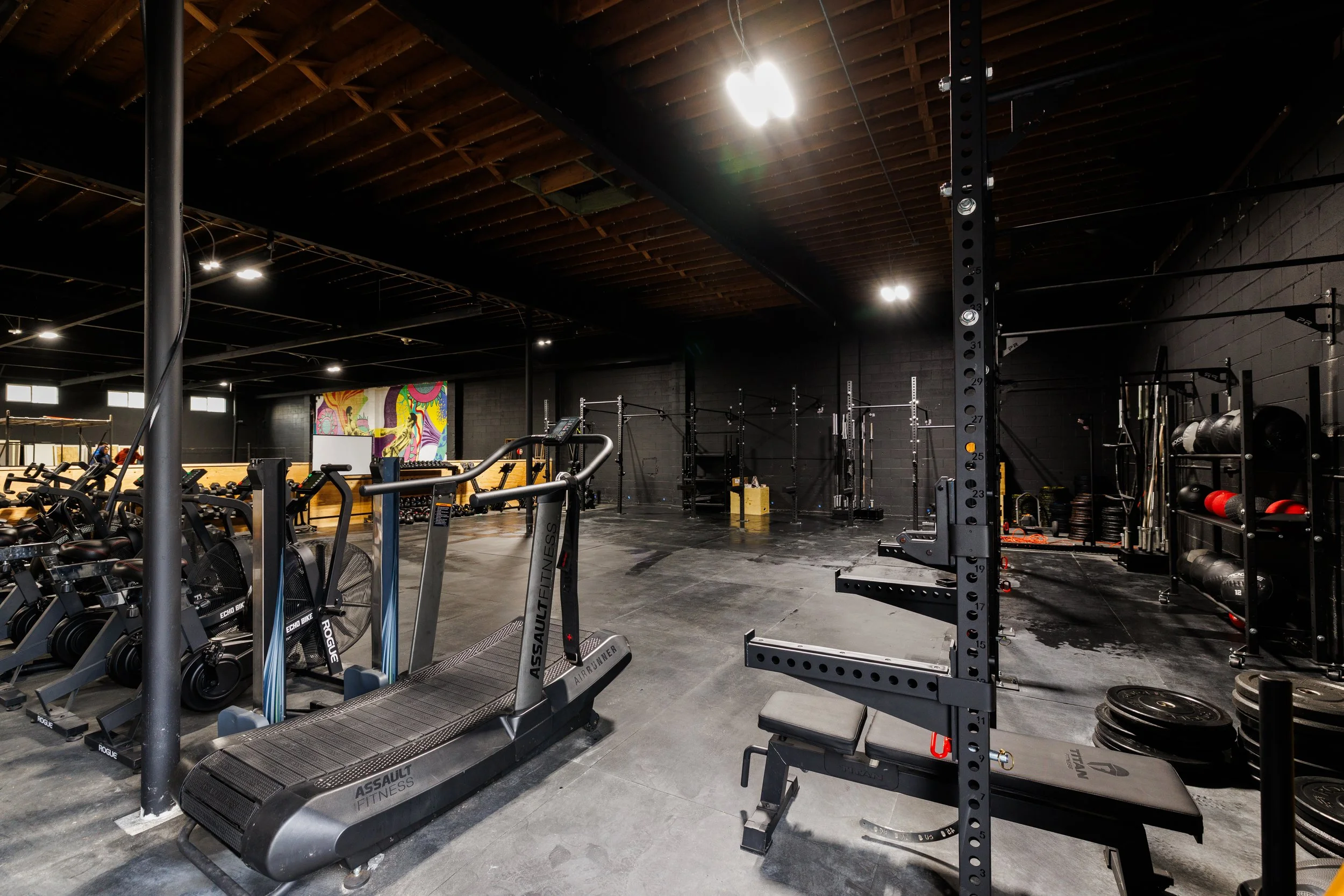
If you do not currently have a regular strength training practice, this is — by a wide margin — the highest-return intervention for desk-related back pain. Our coached strength programs at Root Strength are designed by Doctors of Physical Therapy, and every session includes the hip, core, and posterior chain work that directly counteracts the effects of prolonged sitting.
4. Aerobic exercise
Walking, cycling, swimming, and other forms of aerobic activity have consistently demonstrated analgesic effects for low back pain. The mechanisms include exercise-induced hypoalgesia (the pain-reducing effect of aerobic activity), improved disc nutrition through cyclic loading, enhanced blood flow to spinal structures, and the psychological benefits of regular movement. Even 20 to 30 minutes of walking per day provides measurable benefit for desk-related back pain.
5. Workstation setup — helpful, not sufficient
Monitor at eye level. Feet flat on the floor. Forearms roughly parallel to the desk surface. These are reasonable baseline ergonomic recommendations, and they reduce unnecessary strain on the neck and upper back. But they are not a treatment for low back pain. Think of workstation setup as reducing unnecessary aggravating factors — not as a substitute for the movement and strengthening your body needs.
When to see a physical therapist
Most desk-related low back pain responds well to the behavioral and exercise interventions described above. However, certain presentations warrant a clinical evaluation:
- Pain that radiates into the leg — especially below the knee
- Numbness, tingling, or weakness in a leg or foot
- Pain that worsens progressively over weeks despite movement and exercise
- Pain that wakes you from sleep
- Bowel or bladder changes associated with back pain (seek evaluation immediately)
- Pain following a specific incident (fall, lift, or sudden onset)
Even in the absence of these red flags, a physical therapy evaluation can be valuable if you have been managing low back pain for more than a few weeks without improvement. A clinician can identify specific movement impairments, assess whether hip or core weakness is contributing, differentiate between pain sources, and build an individualized program that is more effective than generic recommendations.
In Washington State, you do not need a referral to see a physical therapist. You can schedule directly.
How we approach desk-related back pain at Root Physical Therapy
When a patient presents with low back pain associated with prolonged sitting, our evaluation assesses hip mobility (flexor length, rotation), gluteal and core strength, lumbar segmental mobility, and movement patterns under load. We do not take an X-ray of your spine and point to degenerative changes as the cause of your pain — because the research clearly demonstrates that imaging findings correlate poorly with symptoms in the majority of cases (Brinjikji et al., 2015).
Treatment typically includes manual therapy to address joint stiffness and soft tissue restrictions, a structured home exercise program targeting the specific deficits identified in your evaluation, movement coaching for your daily work environment, and progressive strengthening through our on-site facility at Root Strength.
The goal is not to make sitting painless forever. It is to build a body that can tolerate sitting — along with everything else you want to do — without pain. That requires building capacity, not buying a better chair.
Dealing with back pain from your desk?
Schedule an evaluation with our Doctors of Physical Therapy. We will identify what is driving your pain and build a plan that resolves it — not just manages it.
Request an appointmentSources
- Korakakis V, O'Sullivan K, O'Sullivan PB, et al. Physiotherapist perceptions of optimal sitting and standing posture. Musculoskeletal Science and Practice. 2019;39:24–31. doi:10.1016/j.msksp.2018.11.004
- Russo F, Papalia GF, Vadalà G, et al. The effects of workplace interventions on low back pain in workers: a systematic review and meta-analysis. International Journal of Environmental Research and Public Health. 2021;18:12614. doi:10.3390/ijerph182312614
- Agarwal S, Steinmaus C, Harris-Adamson C. Sit-stand workstations and impact on low back discomfort: a systematic review and meta-analysis. Ergonomics. 2018;61(4):538–552. doi:10.1080/00140139.2017.1402960
- Waongenngarm P, van der Beek AJ, Akkarakittichoke N, et al. Effects of an active break and postural shift intervention on preventing neck and low-back pain among high-risk office workers: a 3-arm cluster-randomized controlled trial. Scandinavian Journal of Work, Environment & Health. 2021;47(4):306–317. doi:10.5271/sjweh.3949
- Gibbs BB, Hergenroeder AL, Perdomo SJ, et al. Reducing sedentary behavior to decrease chronic low back pain: the Stand Back randomized trial. Journal of Physical Activity and Health. 2021;18(8):936–943. doi:10.1123/jpah.2020-0766
- Alzahrani H, Alshehri MA, Alzhrani M, et al. The association between sedentary behavior and low back pain in adults: a systematic review and meta-analysis of longitudinal studies. PeerJ. 2022;10:e13127. doi:10.7717/peerj.13127
- Alaca N, Acar AÖ, Öztürk S. Low back pain and sitting time, posture and behavior in office workers: a scoping review. Journal of Occupational Rehabilitation. 2025. doi:10.1177/10538127251320320
- Maher C, Underwood M, Buchbinder R. Non-specific low back pain. The Lancet. 2017;389(10070):736–747. doi:10.1016/S0140-6736(16)30970-9
- Brinjikji W, Luetmer PH, Comstock B, et al. Systematic literature review of imaging features of spinal degeneration in asymptomatic populations. American Journal of Neuroradiology. 2015;36(4):811–816. doi:10.3174/ajnr.A4173